
For local affiliate clinical teams
Bring your country's best sites to global studies, with the evidence
The situationGlobal teams ask which local sites can deliver a new protocol. The answer depends on knowledge spread across colleagues, spreadsheets, registries and old feasibility questionnaires.
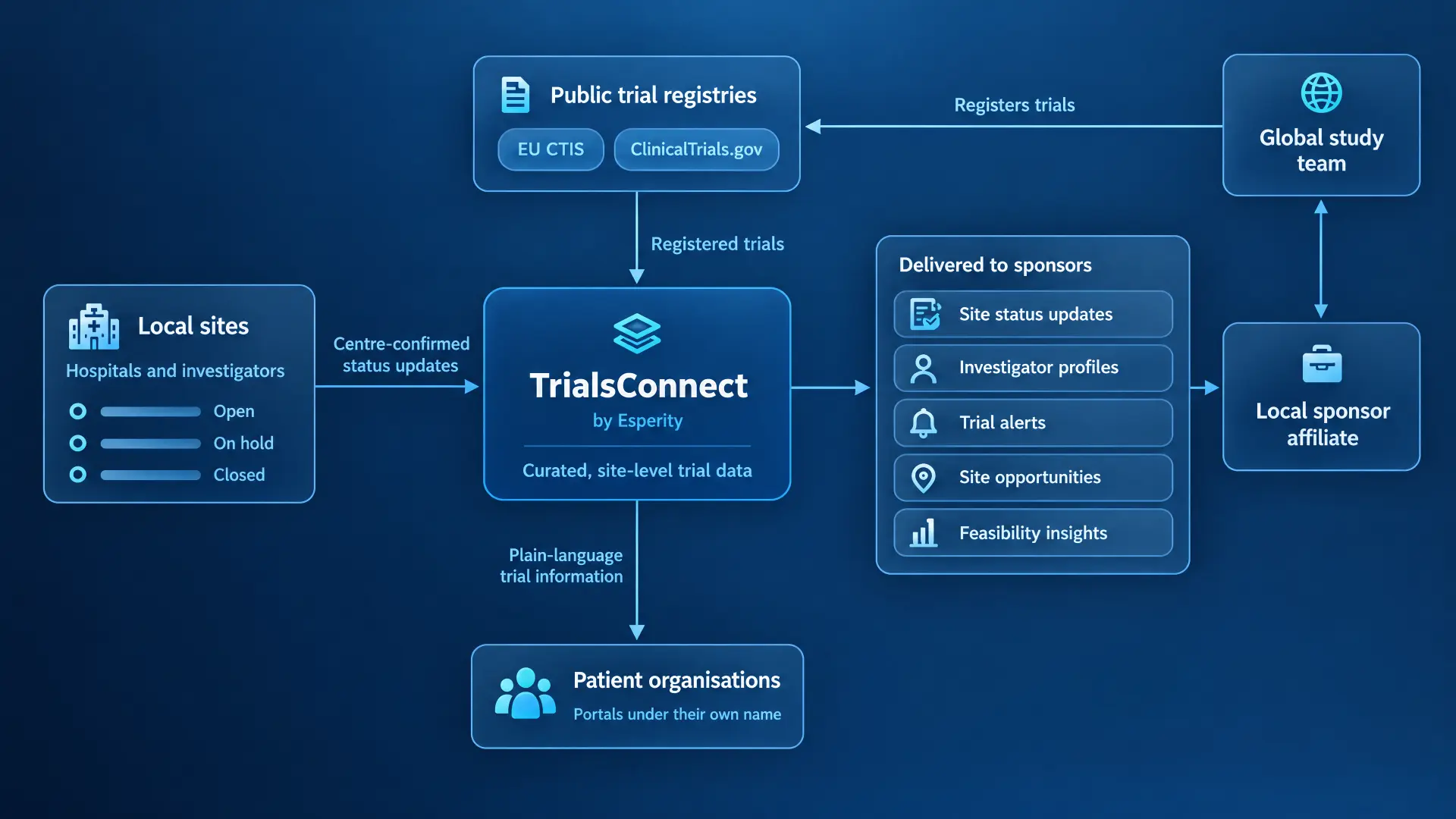
TrialsConnect helps country clinical operations, feasibility, start-up and site engagement teams find suitable investigators and sites, follow what changes locally, and give global study teams recommendations backed by current, sourced information.
What it brings to your country team
Your affiliate knows the country's investigators, hospitals, capabilities and practical constraints. TrialsConnect makes that knowledge easier to keep current, compare and use.
Suitable sites and investigators, shortlisted
Combine investigator experience by indication, population, biomarker and phase with site capabilities, current research activity, declared interest and competing studies, and see what still needs confirming.
A stronger case for your country
Give the global team a structured proposal: which sites, why they fit the protocol, what is confirmed, which competing studies matter, reasonable timing and the open questions.
A current view of each site
Dated, attributable local updates: recruiting, paused or resumed, a new investigator or contact, new capabilities, constraints or readiness. Where a registry and a site disagree, both are shown with their dates.
Competing-trial changes, early
Alerts for a new study in a similar population, a competing study starting locally, a pause or closure at a site you follow, or a new study in a PI's portfolio, each with the reason it is relevant.
Less repetitive feasibility work
Sites keep one capability profile for facilities, departments, equipment and teams. You ask only the protocol-specific questions: procedures, testing, visit schedule, patient estimates.
Better timing and readiness discussions
Recorded activation and recruitment milestones, planned windows, site-reported availability and open requirements help you see when a site is worth revisiting.
New investigators and sites
Find investigators newly identified in a therapeutic area, hospitals outside your usual network, and sites reporting new capabilities or interest in certain study types.
Problems noticed earlier
A research contact leaving, a test no longer available, a visit schedule a site finds hard to support: a change is flagged, a colleague confirms what it means, the recommendation is updated.
One briefing for affiliate, global team and CRO
Why a site was proposed, what is confirmed, what the site reported, what is uncertain and what changed since the last review, so nobody circulates a different version.
The local-to-global feasibility report
It makes the reasoning behind a recommendation visible: a global reviewer sees why a site looks promising and what remains uncertain.
| Report section | What it helps the global team assess |
|---|---|
| Proposed sites and PIs | Which candidates merit further assessment, and why |
| Protocol fit | Relevant investigator experience, site capabilities and requirements still to confirm |
| Current research activity | Studies running at each site and any relevant overlap |
| Local status and interest | What the site reported, when, and for which study |
| Timing and dependencies | Recorded milestones, proposed windows and outstanding requirements |
| Evidence and open questions | Sources, update dates, assumptions, conflicting information and missing data |
| Recommended next steps | Targeted confirmations, the colleague responsible and follow-up dates |
An example: proposing sites for a biomarker-defined study
The request
The global study team asks the affiliate to propose sites for a trial in a defined biomarker population.
Three candidates
Site A has strong experience but overlapping studies. Site B has less overlap, testing not yet confirmed. Site C is newly identified, with relevant experience and an updated capability profile.
Focused questions
The affiliate reuses the existing profiles and asks only about testing, staffing, patient estimates, interest and readiness.
A clear comparison
Global colleagues receive the strengths and open questions per site. If a relevant study changes status later, the team revisits the recommendation with the site.
Clear about what is known
So you can tell confirmed facts from assumptions.
- Every item shows its source and date. Registry records and site contributions are shown side by side.
- Planned dates are kept apart from observed milestones. A study's completion date does not show when a PI has capacity, and a number of ongoing studies does not show workload.
- An overlap alert explains why it matters: population, biomarkers, eligibility, treatment setting, geography and timing, not indication alone.
- A newly identified investigator may already be experienced: the profile shows the evidence, your team decides what to assess.
- Your company's recommendations, notes and follow-ups stay separate from what sites share on the platform.
- Final site selection follows your company's own study-planning process. TrialsConnect complements your trial-management systems.
Five things your team gets
Current local site information
What sites are reporting now, with dates.
PI and site profiles
Experience and capabilities, assessed together.
Competing-trial awareness
Changes in competing studies and local site activity that affect your plans.
Site opportunities
Candidates worth assessing for a specific protocol.
Feasibility reports for global teams
Local recommendations with their supporting evidence.
In a pilot we measure the time to a substantiated shortlist, repeated information requests avoided, accuracy and freshness of key profile fields, usefulness of alerts, and how often global reviewers still ask for basic missing information.
See it for your next protocol
In 20 minutes we show site profiles, competing-trial alerts and a feasibility report for your indication, with illustrative data.