
For medical affairs and MSLs
A current scientific briefing on every investigator you work with
The situationBefore a scientific discussion, the facts about an investigator are spread across registries, institutional websites and old notes, and they are rarely current for the investigator's own site.
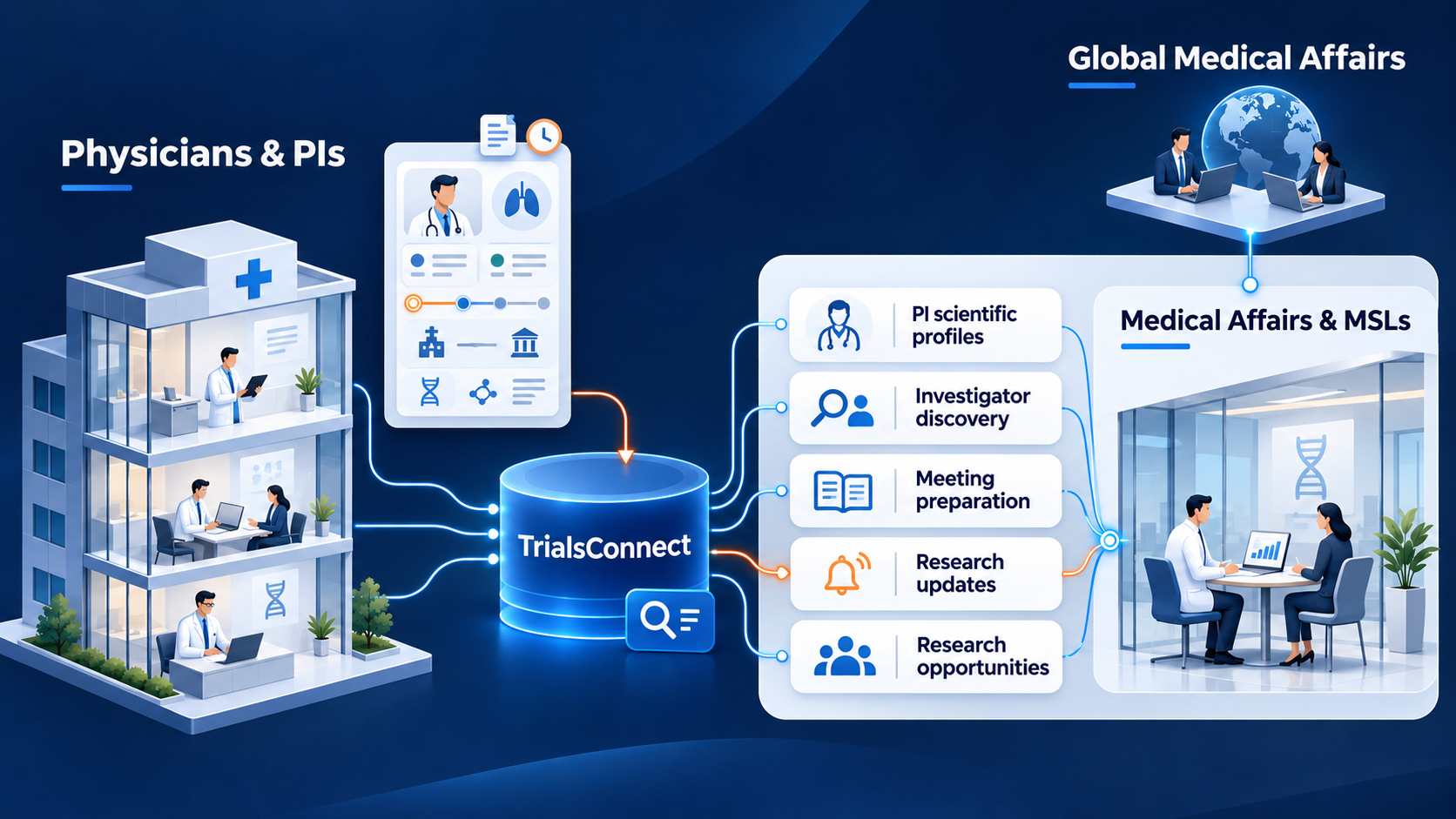
TrialsConnect links an investigator's profile to what is happening at their own site: expertise, research activity, collaborations, local study status and declared interests, each with its source and date.
What it brings to medical affairs
Built around the established MSL role: scientific exchange, evidence generation and gathering insights from healthcare professionals.
Better-prepared scientific discussions
One concise profile with the indications, subtypes and biomarkers an investigator works on, their current studies and role, recent site changes and interests they shared themselves.
Experts matched to a scientific question
Find physicians by patient population, methodology, endpoint, diagnostic approach or phase, for advisory discussions, protocol feedback, education or research.
Investigators beyond your existing contacts
Be told when someone starts studies in your area, joins a new institution or network, or declares a new interest, with the reason they are relevant.
Research activity in context
Ongoing and previous studies, documented sponsor relationships and institutional collaborations show how an investigator's focus has evolved.
A clear “What changed?”
A new study, a recruitment change at their site, a new affiliation or capability, or a newly declared interest: a prompt to refresh your briefing.
Potential research collaborators
Spot investigators whose experience fits an observational study, registry, patient-reported outcomes or an investigator-initiated proposal.
Context for medical insights
Read a physician's observation alongside their specialty, study experience and site capabilities. The conversation gives the insight; the profile gives its context.
One fact base for local and global teams
Brief global colleagues, hand over a territory or prepare an advisory meeting from the same sourced profile, without asking sites again.
What a profile contains
Every item shows its source and date, and whether it was reported by the site or PI or inferred from research activity.
| Section | Content | Why it helps |
|---|---|---|
| Identity and affiliations | Verified name, institution, department, investigator role and linked sites | The right person in the right research setting |
| Scientific expertise | Specialty, indications, disease subtypes, biomarkers and documented methodological experience | More precise scientific matching |
| Research interests | Interests declared by the PI, kept apart from topics inferred from research activity | A clear basis for relevance |
| Trial portfolio | Current and past studies with the investigator's role, phase, site and sponsor | Context for scientific discussions |
| Local activity | Status at the investigator's own site, dated local updates and relevant capabilities | What is really happening at that institution |
| Recent changes | New studies, affiliations, milestones, capabilities or declared interests | Useful for ongoing monitoring |
| Scientific outputs | Reliably matched publications, abstracts and congress contributions, where available | Evidence of scientific contribution |
| Sources and freshness | Source links, update dates, and reported or inferred | Know what is reliable and what to confirm |
An example: preparing to meet a lung cancer investigator
Prepare
The profile shows studies with a particular biomarker, a study that has just paused recruitment at the site, and the PI's declared interest in diagnostic pathways.
Discuss
The MSL brings relevant scientific material and questions. The physician describes a problem with access to testing.
Record with context
The team records the observation with its research context attached, so it can be weighed properly.
Share
A global colleague reads the same profile and sees why this investigator matters for a wider evidence question.
The profile supports preparation and discovery. The discussion establishes the physician's actual needs, views and interest in working together.
Facts, clearly sourced
So teams can rely on what they read, and know what to confirm.
- Profiles are visible only for physicians who chose to be visible.
- Status at the investigator's own site is kept apart from study-wide status.
- Recorded milestones are kept apart from planned dates. A study's completion date says nothing about a PI's availability.
- A study relationship shows research experience, not the physician's opinion of a sponsor or treatment.
- Your own notes from scientific exchanges stay in your company's own workspace, separate from the shared facts.
- No patient data and no promotional content.
Three things that change for your team
Relevant investigators, found
Physicians whose documented expertise matches a scientific topic.
Better meeting preparation
Current research activity and local context in one concise briefing.
One shared understanding
Local and global medical teams work from the same sourced information.
In a pilot we measure briefing preparation time, profile accuracy, the usefulness of alerts and the relevance of suggested investigators.
See a profile for your therapeutic area
In 20 minutes we show investigator profiles and change alerts for your indication, with illustrative data.